
Why SEO and AI SEO Has Become the Most Important Investment a Hotel Can Make
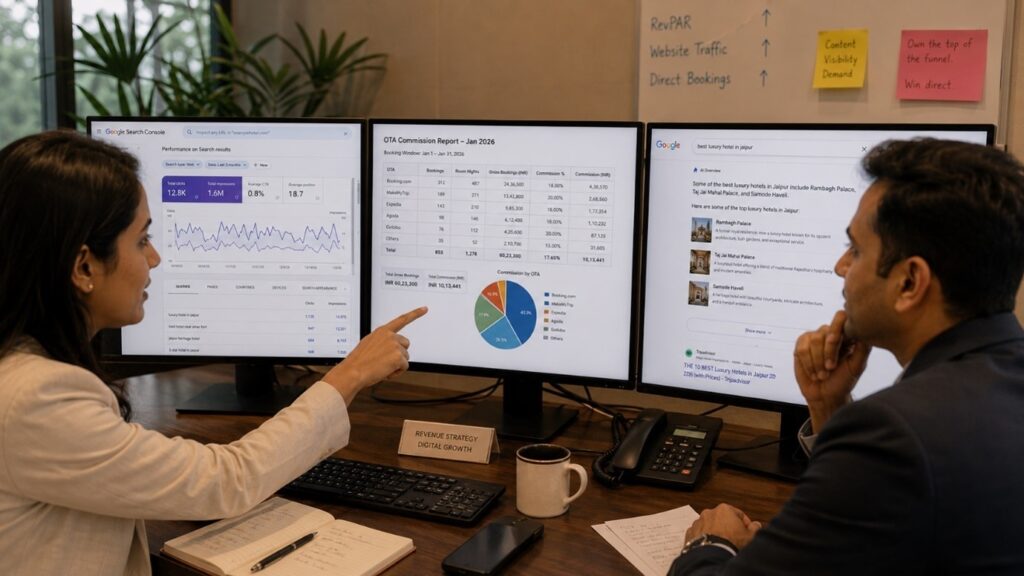
The average hotel in India continues to pay between 15 and 25 percent commission on every booking that comes through an OTA. The economics of that arrangement have not improved. The OTAs have, if anything, become more dominant in the search results as they have invested heavily in both traditional SEO and AI search visibility. Every booking that comes through an OTA rather than the hotel’s direct channel is a booking where a significant portion of the revenue has been paid to the OTA before the guest has checked in.
The fix for this issue is not a complicated one conceptually. It is SEO. Specifically, it is the kind of SEO built for how search actually works in 2026, which includes both traditional Google ranking and the AI-powered answer interfaces that are now handling a significant and growing proportion of travel search queries.
The brands that have invested in this properly are reducing OTA dependency measurably. The ones that have not are watching their direct booking percentages stay flat or decline while their commission costs compound.
How Hotel Search Has Changed
The travel research process has shifted considerably. A guest planning a hotel stay in 2026 is not just typing the hotel name into Google and clicking the website. They are reading Google AI Overviews that synthesise information from multiple sources before presenting an answer or they are using ChatGPT to compare properties, understand neighbourhoods, get dining recommendations for a stay, and evaluate whether a specific hotel matches their specific requirements.
In every one of these interactions, the hotel either appears or it does not. And the appearance is determined by the quality and depth of the hotel’s online content, the technical health of the website, the authority signals that the hotel has built across the web, and the degree to which the hotel’s content is structured in a way that AI systems can extract and cite accurately.
The top hotel digital marketing agencies in India that have adapted to this are building SEO programmes that address all of these layers simultaneously rather than treating them as separate initiatives.
What AI SEO Means for Hotels Specifically
Traditional SEO for hotels meant ranking on Google for searches like hotels in Jaipur or luxury hotel near Udaipur airport. That work still matters and still drives direct booking traffic. But AI SEO is a layer on top of that which is becoming equally important.
When a prospective guest asks a large language model to recommend a luxury hotel in a specific city with specific facilities, the model’s answer comes from its training data and real-time web access. The hotel that has comprehensive, well-structured, authoritative content across its own website and across third-party sources is the hotel that gets cited. The hotel that has a thin website, minimal content depth, and weak external authority is invisible in that answer regardless of how good the property actually is.
The best hotel SEO agencies in India are building what is sometimes called LLM visibility alongside traditional search rankings. This means content that answers the specific questions a prospective guest asks, structured in a way that an AI can extract a clean answer from. It means consistent, accurate information across every platform where the hotel has a presence. It means genuine authority signals built through hospitality publications, travel content sites, and credible third-party mentions rather than low-quality link building.
For luxury hotel brands specifically, the AI search layer is particularly important because the audience making luxury hotel decisions is using AI search interfaces at a higher rate than the general travel market. Luxury hotel marketing agencies in India that understand this are proactively advising and assisting clients for AI SEO as a priority rather than a future consideration.
The Direct Booking Economics
The business case for hotel SEO investment is straightforward when you put the numbers next to each other.
An OTA booking costs 15 to 25 percent of the booking value in commission. A direct booking through the hotel website costs the ongoing investment in SEO and digital presence, which amortises across every booking it generates. For a hotel doing meaningful volume, the cost per direct booking through organic search is a fraction of the OTA commission cost on an equivalent booking. The ROI on properly executed hotel SEO is not close. It is substantial.
The brands that understand this are allocating meaningful budget to it. The brands that do not are making an implicit choice to keep paying OTA commissions indefinitely rather than investing in the asset that reduces that dependency over time.
The top hotel marketing agencies in India are having this conversation with clients at the revenue level rather than the marketing level because that is where the decision actually belongs. Hotel SEO is not a marketing expense. It is a revenue infrastructure investment.
What Good Hotel SEO Looks Like in 2026
The hotel SEO programmes that are actually producing results in 2026 have several things in common. They have content depth that answers every question a prospective guest might have about the property, the destination, the experience, the dining, the facilities, and the occasions the hotel is suited for. Not thin pages with basic information but genuine, specific, useful content that earns trust from both human readers and AI systems.
They have technical foundations that give the content the best possible chance of being crawled, indexed, and understood correctly. Page speed, structured data, mobile experience, and Core Web Vitals are not aspirational targets. They are baseline requirements.
And they are being actively maintained rather than treated as a one-time project. Search and AI visibility is not a build-it-and-leave-it channel. It requires ongoing content production, technical monitoring, and adaptation to how the search landscape continues to evolve.
Templatolio works with hotel brands across India on SEO and AI SEO programmes built around direct booking growth. The work addresses traditional search rankings, AI Overview visibility, and LLM citation alongside the technical and content foundations that make both possible. If your hotel’s direct booking percentage is not moving in the right direction, the SEO programme is the place to look first.
Frequently Asked Questions
Because AI search interfaces are now shaping hotel booking decisions before any OTA is consulted, and the hotels with strong SEO are capturing that consideration-stage traffic directly.
Traditional SEO optimises for Google rankings. AI SEO optimises for being cited and recommended by AI search interfaces including Google AI Overviews, ChatGPT, and Perplexity.
Through comprehensive content depth, structured data, external authority building, and consistent accurate information across all platforms where the hotel has presence.
Detailed pages covering the property experience, destination guides, dining content, occasion and event information, and specific answers to the questions prospective guests ask during research.
This varies by property and market but hotels with strong SEO programmes consistently report direct booking growth that meaningfully reduces OTA dependency over 12 to 18 months.
It is particularly important for luxury hotels because the audience making luxury booking decisions uses AI search and organic discovery at a higher rate than general travel segments.
Meaningful improvements in organic visibility typically appear within three to six months. Direct booking impact compounds over twelve to eighteen months of consistent investment.
Page speed, mobile experience, structured data markup, Core Web Vitals, and clean site architecture are the baseline technical requirements for competitive hotel SEO.
Yes, Templatolio builds SEO and AI SEO programmes for hotel brands across segments with a specific focus on direct booking growth and OTA commission reduction.
Visit templatolio.com and reach out directly through the website to discuss your property, current search visibility, and direct booking objectives.
Is Your Hotel Paying Too Much in OTA Commissions?
Templatolio works with hotel brands and hospitality businesses across India on SEO and AI SEO programmes built to grow direct bookings and reduce OTA dependency. If the gap between your current direct booking percentage and where it should be feels significant, the conversation is the right place to start.
Email: info@templatolio.com
Click here to Talk to the team.
Visit: https://templatolio.com/ Reach out through the website to discuss your hotel’s search visibility and direct booking strategy.