
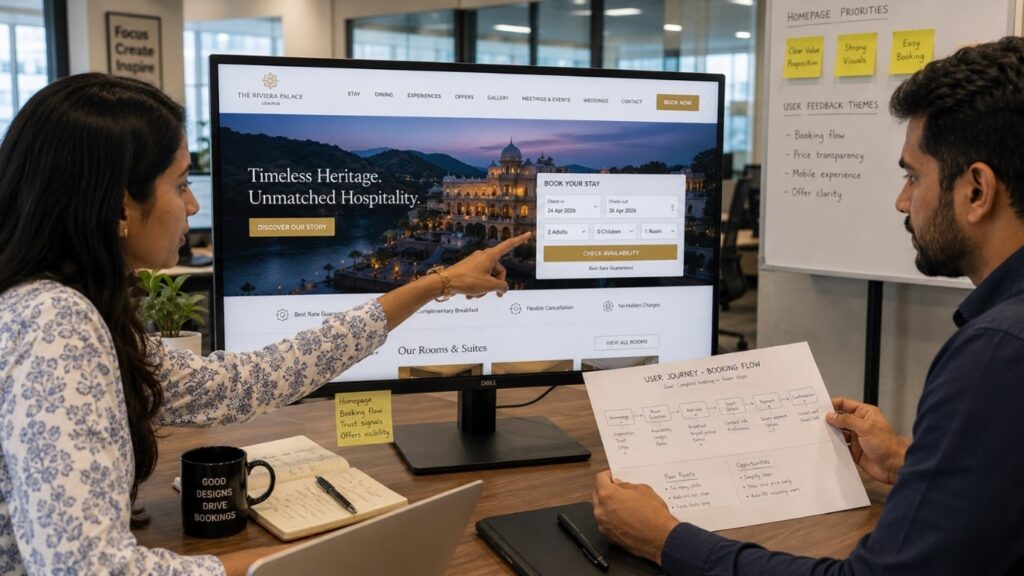
What a Hotel Website Needs to Do and Why Most Are Not Doing It
A prospective guest has found your hotel through a Google search, a social media post, or a recommendation from a friend. They click through to your website. What happens in the next thirty seconds determines whether they book directly or leave and complete the booking on an OTA where you will pay a commission on the revenue you just generated through your own marketing.
The hotel website is not a brochure. It is a hotel positioning and a booking conversion tool. Every design decision on it either helps or hinders that function, and in a market where OTA commission costs are a material line item on most hotel P&Ls, the design quality of the direct booking channel is a business problem with a measurable financial consequence.
This is what the best hotel digital marketing agencies in India are telling clients about hotel website design in 2026, and most of it is not complicated. It is just not widely implemented.
The First Impression Happens in Two Seconds
The hero section of a hotel website homepage carries an unreasonable amount of weight. It is where the visitor either decides to continue or does not, and that decision happens faster than any amount of good content further down the page can recover.
The most common mistake in hotel website hero design is prioritising visual impact over informational clarity. A full-screen video of the property’s architecture is beautiful but if the viewer cannot identify within two seconds what kind of property this is, where it is, and who it is for, the visual beauty is working against conversion rather than for it.
The best hotel website designs in 2026 combine strong visual quality with immediate clarity. The property character is communicated through imagery. The location is stated. A booking widget or a clear path to one is visible without scrolling. And the headline, if there is one, says something specific about the property rather than a generic aspiration that could apply to any hotel anywhere.
Top hotel marketing agencies in India designing hotel websites are increasingly testing hero sections not for visual approval from the client but for information transmission from the visitor. The question is not whether it looks good. It is whether someone who has never seen the property before knows what they are looking at after two seconds.
The Booking Engine Is Not a Separate Decision from the Website
This is a mistake that a surprising number of hotel websites are still making in 2026. The booking engine is treated as a technical procurement decision separate from the website design, resulting in a jarring transition where the guest moves from a beautifully designed website into a booking interface that looks and feels like a different product from a different decade.
The drop-off rate at the booking engine transition point on hotel websites is one of the most significant sources of direct booking loss. The visitor was convinced enough by the website to click Book Now. The booking engine design then introduces enough friction and visual inconsistency to create doubt and hesitation. A meaningful proportion of those guests abandon the booking and complete it on an OTA where the interface is familiar and trustworthy.
The top hospitality digital marketing agencies in India advise clients to evaluate the booking engine as part of the website design brief rather than after it. The transition needs to be seamless. The booking interface needs to match the visual language of the website. The flow needs to be short, clear, and mobile-optimised because a significant and growing proportion of hotel bookings in India are initiated on mobile.
Mobile Is Not a Secondary Experience
This should not need to be said in 2026 but the evidence from hotel websites across India suggests it still does. A hotel website that provides a good desktop experience and a tolerable mobile experience is a hotel website that is converting desktop visitors and losing mobile visitors to OTAs.
The mobile booking journey for a hotel has specific design requirements that are different from desktop. Touch targets need to be appropriately sized. The booking widget needs to work without requiring precise input on a small screen. Photography needs to load quickly without sacrificing quality. Navigation needs to be accessible without requiring a desktop-style menu structure.
The best hotel SEO agencies in India are also flagging mobile performance as an SEO issue as much as a design issue. Google uses mobile page experience as a ranking signal. A hotel website with poor mobile performance is losing both visitors and search visibility simultaneously.
Content Depth and Structure Affects Both Conversion and SEO
A hotel website needs to carry enough content depth to serve two audiences simultaneously. The human visitor who is evaluating the property and making a booking decision as well as the search and AI systems that are determining how visible the website is in organic search and AI-generated answers.
These two audiences have more in common than they might seem. Both want specific, detailed, accurate information about the property. Both respond to content that answers real questions rather than marketing language that avoids saying anything specific and both make decisions based on the trust signals that detailed, honest content provides.
Luxury hotel marketing agencies in India designing websites for premium properties are increasingly building content architecture that covers the full range of questions a prospective guest might have. Not just the rooms and facilities but the experience of arriving, the dining in detail, the occasions the property is suited for, the local area, and the specific character of the stay. This content serves the guest considering a booking and the AI system deciding whether to cite this property in a search response.
Speed Is a Design Decision
Page load speed is not a technical afterthought to be addressed after the design is complete. It is a design decision made at every stage of the website build. The image file sizes, the video formats, the third-party scripts, the font loading behaviour and the animation complexity all affect how quickly the page loads and therefore how many visitors stay long enough to book.
The relationship between page speed and conversion rate on hotel websites is direct and documented. Pages that load slowly have higher bounce rates. Higher bounce rates mean fewer bookings. For hotels running paid campaigns to drive traffic to the website, slow page speed is effectively a tax on every pound of media spend because a proportion of every campaign’s traffic is being lost before the page finishes loading.
Templatolio works with hotel brands across India on website design and development that treats UI/UX, look & feel, conversion, SEO, mobile experience, and speed as integrated design requirements rather than separate workstreams. If your hotel website is not converting the traffic it is receiving into direct bookings at the rate it should, the design is almost certainly part of the explanation.
Frequently Asked Questions
Converting direct booking intent into completed bookings rather than sending visitors to OTAs, which requires clarity, speed, mobile optimisation, and a seamless booking engine experience.
With strong visual quality combined with immediate informational clarity about property type, location, and character, with a booking path visible without scrolling.
A visual mismatch between the hotel website and the booking engine creates friction and doubt that causes a measurable proportion of visitors to abandon and rebook on OTAs.
Critical. A significant proportion of hotel bookings in India are initiated on mobile and poor mobile experience affects both conversion and Google search ranking simultaneously.
Detailed dining content, arrival experience, occasion-specific pages, local area attractions information, events spaces and specific property character content that serves both human visitors and AI search systems.
Slow loading pages have higher bounce rates and lower conversion. For hotels running paid media, poor page speed reduces the return on every campaign.
Yes, Templatolio builds hotel websites with conversion, SEO, mobile experience, and content depth as integrated design objectives from the start of the project.
AI systems including Google AI Overview cite hotels whose websites contain comprehensive, specific, and well-structured answers to the questions prospective guests ask during research.
This varies by scope but a properly designed hotel website with full content development typically takes eight to sixteen weeks depending on property complexity and content requirements.
Visit templatolio.com and reach out through the website to discuss your current site, direct booking objectives, and what a redesign brief would look like for your property.
Is Your Hotel Website Converting Visitors or Sending Them to an OTA?
Templatolio works with hotel and hospitality brands across India on website designs that not only look good, have great UI/UX but are built around direct booking conversion, mobile experience, SEO performance, and the content depth that AI search systems reward.
Visit: https://templatolio.com/ Reach out through the website to discuss your hotel’s digital presence and booking conversion.
Email: info@templatolio.com
Click here to Talk to the team.